

One of the most common things drivers say after hitting a motorcyclist is, “I didn’t see them.” But not seeing a motorcycle does not automatically excuse a driver from responsibility. If a driver failed to yield, turned left in front of a motorcycle, changed lanes without checking their blind spot, opened a door into traffic, or followed too closely, they may still be responsible for the crash and the injuries that followed.
Motorcycle accidents are different from regular car accidents. Riders have less protection, injuries are often more serious, and insurance companies may try to blame the motorcyclist even when another driver caused the crash. If you were hit while riding in Connecticut, knowing what to do next can help protect your health, your evidence, and your potential injury claim.
The motorcycle accident lawyers at Haymond Law Firm have worked with injured riders across Connecticut and throughout the Northeast. As Attorney John Haymond says, “If you go down, we’ll pick you up.”
Why “I Didn’t See the Motorcycle” Is Not a Legal Defense
Drivers have a responsibility to watch for motorcycles, just like they must watch for cars, trucks, pedestrians, and bicyclists. Motorcycles are smaller than passenger vehicles, but they are still legal vehicles on the road. A driver cannot simply say they did not see a motorcycle and expect that to end the claim.
Many motorcycle crashes happen because a driver:
- Turned left in front of an oncoming motorcycle
- Changed lanes without checking blind spots
- Failed to yield at an intersection
- Followed too closely
- Opened a car door into the rider’s path
- Entered traffic from a driveway or parking lot without looking carefully
- Was distracted by a phone, GPS, passenger, or radio
- Misjudged the motorcycle’s speed or distance
When a driver says, “I didn’t see the motorcycle,” that statement may actually support the argument that the driver was not paying enough attention. The issue is not just whether the driver saw the rider. The issue is whether the driver acted reasonably and safely before making the turn, lane change, or other movement that caused the crash.
Motorcycle Accident Claims Are Often Unfairly Blamed on the Rider
After a motorcycle crash, insurance companies may look for reasons to blame the rider. They may suggest the motorcycle was speeding, weaving through traffic, riding too close to other vehicles, or should have been more visible. Sometimes these claims are made before the insurance company has fully reviewed the crash scene, damage photos, witness statements, or police report.
This is one reason motorcycle accident cases need to be handled carefully. Evidence matters. The position of the vehicles, the damage to the motorcycle, skid marks, debris, traffic camera footage, dashcam video, nearby business surveillance, and witness statements can all help show what really happened.
If you were injured in a motorcycle crash, do not assume the insurance company’s version of the accident is correct. The insurance company is not on your side. Their goal is to limit what they have to pay. A Connecticut motorcycle accident attorney can help investigate the crash and push back if the rider is being unfairly blamed.
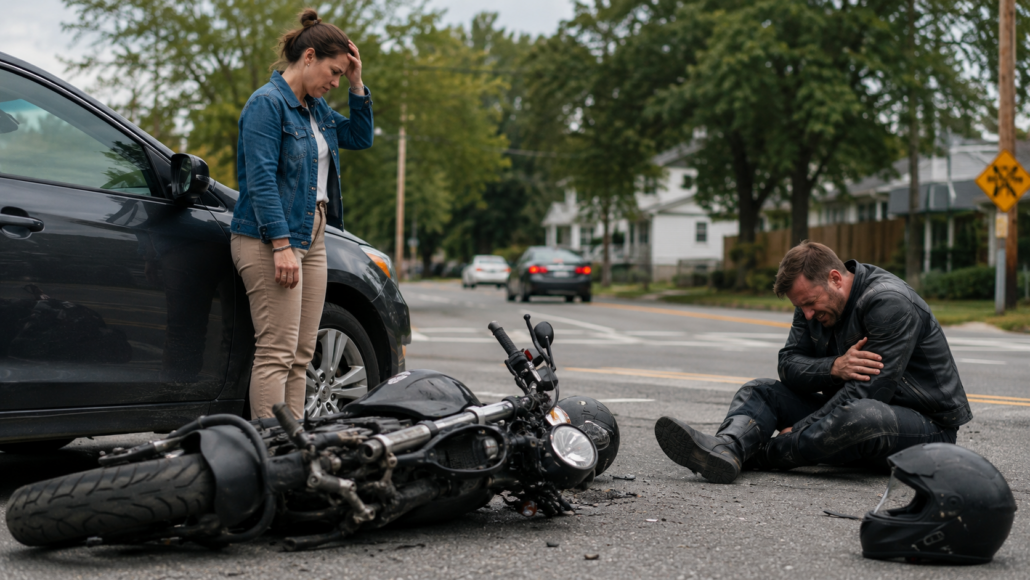
What To Do If You Were Hit on a Motorcycle in Connecticut
After a motorcycle accident, your first priority should always be your safety and medical care. But if you are physically able, there are also important steps that can help protect your injury claim.
1. Call 911 and Request Medical Help
Always call 911 after a motorcycle accident. Even if you think your injuries are minor, motorcycle crashes can cause injuries that get worse over time. Neck injuries, back injuries, head injuries, shoulder injuries, knee injuries, road rash, internal injuries, and nerve damage may not be fully obvious at the scene.
A police report can also become an important piece of evidence. Make sure the officer knows what happened from your perspective. If the driver turned in front of you, changed lanes, failed to yield, or said they did not see you, make sure that information is reported.
2. Get Medical Treatment Right Away
Do not wait days or weeks to get checked out. Insurance companies often use delays in treatment against injured riders. They may argue that you were not seriously hurt or that your injuries came from something else.
If you are in pain, go to the emergency room, urgent care, or your primary care doctor. Follow all medical instructions and keep track of referrals to physical therapy, orthopedic doctors, pain management providers, neurologists, or other specialists.
3. Photograph the Scene, the Motorcycle, and Your Injuries
If it is safe to do so, take photos and videos before the vehicles are moved. Important photos may include:
- The motorcycle’s final position
- The other vehicle’s final position
- Damage to the motorcycle
- Damage to the car or truck
- Skid marks, debris, glass, or fluid on the road
- Traffic lights, stop signs, lane markings, and road conditions
- Visible injuries, bruising, swelling, cuts, and road rash
- Your helmet, jacket, gloves, boots, pants, and other riding gear
These photos can be extremely important if the driver later changes their story or the insurance company tries to blame you.
4. Save Your Helmet and Riding Gear
Do not throw away your helmet, jacket, gloves, boots, pants, or any damaged gear. Even if the items look destroyed, they may help show the force of impact, where your body hit the ground or vehicle, and how serious the crash was.
Damaged gear can also help explain injuries such as road rash, fractures, shoulder trauma, knee injuries, or head impact. Put everything in a safe place and do not repair, wash, sell, or dispose of the items until your case is reviewed.
5. Get Witness Information
Witnesses can make a major difference in a motorcycle accident case. If someone saw the crash, ask for their name and phone number. Witnesses may be able to confirm that the driver turned left, failed to yield, drifted into your lane, or admitted they did not see you.
Do not rely only on the police to collect every witness. People often leave the scene before officers finish investigating.
6. Be Careful Before Speaking With the Insurance Company
You should report the crash to the insurance company, but be careful before giving a recorded statement, signing documents, or accepting a quick settlement. Insurance adjusters may ask questions in a way that makes your answers sound like you were unsure, distracted, speeding, or partly responsible.
Before giving detailed statements, especially to the other driver’s insurance company, consider speaking with an attorney. A lawyer can help protect you from saying something that may be taken out of context later.
Common Motorcycle Accident Injuries
Motorcycle crashes often cause serious injuries because riders do not have the same protection as people inside cars. There is no seat belt, airbag, or enclosed frame protecting the rider from the road, another vehicle, or surrounding objects.
Common motorcycle accident injuries include:
- Broken legs, arms, wrists, ribs, ankles, and collarbones
- Road rash and permanent scarring
- Traumatic brain injuries and concussions
- Neck and back injuries
- Spinal cord injuries
- Shoulder injuries
- Knee injuries and torn ligaments
- Nerve damage
- Internal bleeding or organ injuries
- Burns
- Amputation injuries
- Wrongful death
Even injuries that seem manageable at first can become serious over time. Some riders need surgery, months of physical therapy, injections, pain management, or long-term care. Others are left with permanent limitations that affect work, family life, riding, and daily activities.
Can I Make a Claim If I Was Not Wearing a Helmet?
Possibly. Connecticut’s motorcycle helmet rules changed effective October 1, 2025. According to the Connecticut DMV, motorcycle riders under 21 are required to wear a helmet. Riders who are 21 or older are not required to wear a helmet under that rule.
However, even if helmet use becomes an issue in your case, that does not automatically mean you have no claim. The details matter. The type of injury, the cause of the crash, your age, whether the injury involved your head, and what the other driver did can all affect the case.
For example, if a driver turned left in front of you and you suffered a broken leg, shoulder injury, back injury, or road rash, the insurance company should not be allowed to use helmet arguments to distract from what caused the crash. Connecticut injury claims can involve complicated questions about fault and damages, so it is important to speak with a lawyer before assuming you do or do not have a case.
You can read more about Connecticut’s current motorcycle safety rules through the Connecticut DMV’s October 2025 law update.
What If the Driver Turned Left in Front of My Motorcycle?
Left-turn motorcycle accidents are among the most common and dangerous types of motorcycle crashes. These crashes often happen when a driver turns left across traffic and fails to properly judge the motorcycle’s distance or speed.
The driver may say:
- “I didn’t see the motorcycle.”
- “The motorcycle came out of nowhere.”
- “The rider must have been speeding.”
- “I thought I had enough time to turn.”
But those statements do not automatically make the rider responsible. Drivers must look carefully before turning. If a driver turns when it is not safe and hits an oncoming motorcyclist, the driver may be responsible for the injuries caused by the crash.
Evidence in a left-turn motorcycle accident may include vehicle damage, crash location, witness statements, traffic light timing, surveillance video, police diagrams, and accident reconstruction.
What If the Insurance Company Says I Was Speeding?
Insurance companies often claim motorcyclists were speeding, even when there is limited evidence to support it. Sometimes this is based on assumptions about riders rather than facts.
If speeding is alleged, your attorney may look at:
- The police report
- Witness statements
- Damage patterns
- Skid marks
- Traffic camera or surveillance footage
- Dashcam footage
- Event data from involved vehicles, when available
- Accident reconstruction evidence
Even if there is an argument that a rider was partly responsible, that does not always end the case. Connecticut follows a comparative negligence system, which means fault may be divided between the parties. Under Connecticut law, an injured person’s damages may be reduced by their percentage of fault, and recovery may be barred if their percentage of fault is greater than the combined negligence of the responsible parties.
You can review Connecticut’s comparative negligence statute here: Connecticut General Statutes § 52-572h.
Why Motorcycle Accident Evidence Needs To Be Preserved Quickly
Motorcycle accident evidence can disappear fast. Vehicles get repaired, debris is cleared, witnesses become difficult to find, and surveillance footage may be deleted within days or weeks.
That is why injured riders should act quickly. A motorcycle accident lawyer may be able to send preservation letters, investigate the crash scene, contact witnesses, request available footage, review the police report, and help document the full impact of the injuries.
This is especially important if the driver is already blaming you or if the insurance company is pressuring you to give a statement.
How Motorcycle Accidents Are Different From Car Accidents
Motorcycle accident claims often involve higher stakes than ordinary car accident claims. Riders are more exposed, so the injuries are often more serious. Medical bills may be higher, time out of work may be longer, and the physical recovery can be more difficult.
There is also a bias problem. Some people assume motorcyclists are reckless simply because they ride. That assumption is unfair and can affect how insurance companies approach a claim.
A strong motorcycle accident case should focus on evidence, not stereotypes. The question should be: What did each person do before the crash, and who failed to follow the rules of the road?
If your accident involved a car, truck, rideshare vehicle, or commercial vehicle, Haymond Law Firm also handles related claims involving car accidents, truck and tractor trailer accidents, and Uber accident claims.
Motorcycle Safety and Crash Risk in 2026
Motorcyclists remain among the most vulnerable people on the road. The National Highway Traffic Safety Administration reports that 6,228 motorcyclists were killed in traffic crashes in 2024, representing 16% of all traffic fatalities. NHTSA also reminds both drivers and riders to share the road, stay alert, avoid impairment, and make motorcycles more visible.
You can review NHTSA’s motorcycle safety information here: NHTSA Motorcycle Safety.
Connecticut also offers motorcycle rider education through the Connecticut Rider Education Program. The state notes that new riders are required to pass a basic riding and safety program before getting a motorcycle license, and the program also encourages drivers of cars and trucks to respect and protect people on motorcycles.
You can review Connecticut’s motorcycle rider education information here: Connecticut Rider Education Program.
When Should I Call a Motorcycle Accident Lawyer?
You should consider calling a motorcycle accident lawyer if:
- You were injured in the crash
- You went to the hospital, urgent care, or a doctor
- You are missing work because of your injuries
- The driver is blaming you
- The insurance company wants a recorded statement
- Your motorcycle was seriously damaged or totaled
- You may need surgery, injections, physical therapy, or specialist care
- The crash involved a commercial vehicle, rideshare driver, or uninsured driver
- You suffered scarring, road rash, broken bones, head injuries, neck injuries, or back injuries
- A loved one was killed in a motorcycle crash
The sooner a lawyer gets involved, the sooner important evidence can be preserved. Waiting too long may make it harder to prove what happened.
Why Riders Call Haymond Law Firm After a Motorcycle Crash
Haymond Law Firm has a long history of helping injured motorcycle riders. Attorney John Haymond is also an avid motorcycle enthusiast and has worked with charitable events within the motorcycle community throughout the Northeast.
The firm’s connection to riders goes beyond the courtroom. Through the Haymond Law Firm community and Ride Guide, the firm has supported motorcycle events, local safety initiatives, charity rides, rallies, and community gatherings for years.
Haymond Law Firm has also published real-life motorcycle accident case results showing examples of how motorcycle injury claims can involve serious disputes, detailed investigation, and major recoveries for injured riders.
If you were hurt in a motorcycle accident in Connecticut, you do not have to face the insurance company alone.
Motorcycle Accident FAQ
Can I sue if the driver said they did not see my motorcycle?
You may be able to make a claim if the driver’s failure to see you was the result of negligence. Drivers are expected to look carefully before turning, changing lanes, pulling out of driveways, or entering traffic. Saying “I didn’t see the motorcycle” does not automatically excuse the driver.
What should I do after being hit on a motorcycle?
Call 911, get medical treatment, document the scene, take photos, save your helmet and gear, get witness information, avoid quick insurance statements, and speak with a motorcycle accident lawyer if you were injured.
Can the insurance company blame me because I ride a motorcycle?
The insurance company may try, but riding a motorcycle does not make you automatically responsible for a crash. Fault should be based on evidence, not assumptions about riders.
What if I was not wearing a helmet?
Helmet use may become an issue depending on your age, the type of injury, and the facts of the crash. As of October 1, 2025, Connecticut requires motorcycle riders under 21 to wear helmets. Riders 21 and older are not required to wear a helmet under that rule. Even if helmet use is raised by the insurance company, it does not automatically mean you have no claim.
What if the driver turned left in front of me?
Left-turn crashes are common motorcycle accident cases. If a driver turned left when it was unsafe and hit an oncoming motorcycle, the driver may be responsible for the rider’s injuries.
Should I give a recorded statement to the insurance company?
Be careful. Insurance adjusters may ask questions designed to limit your claim or make your answers sound like you were partly responsible. Before giving a recorded statement to the other driver’s insurance company, consider speaking with a lawyer.
How much is my motorcycle accident case worth?
The value of a motorcycle accident case depends on many factors, including the severity of your injuries, medical bills, lost wages, pain and suffering, permanent limitations, scarring, property damage, insurance coverage, and who was at fault.
Do I need a lawyer for a motorcycle accident claim?
If you were injured, missed work, need ongoing treatment, or are being blamed for the crash, it is a good idea to speak with a motorcycle accident lawyer. Motorcycle claims are often disputed, and early evidence can make a major difference.
Call Haymond Law Firm After a Motorcycle Accident in Connecticut
If a driver hit you and said they “didn’t see your motorcycle,” do not assume you are out of options. You may still have a claim. The driver may have failed to yield, failed to check their blind spot, turned when it was unsafe, or simply failed to pay proper attention.
The motorcycle accident attorneys at Haymond Law Firm can review your case, explain your options, and help protect your rights after a crash.
Call 1-800-HAYMOND today for a free consultation.
No fee unless we win.
References
- National Highway Traffic Safety Administration — Motorcycle Safety
- Connecticut DMV — New Laws Effective October 2025
- Connecticut Rider Education Program
- Connecticut General Statutes § 52-572h — Comparative Negligence
- Haymond Law Firm — Motorcycle Accident Attorney
- Haymond Law Firm — Real Life Motorcycle Accident Case Results
This article is for general informational purposes only and is not legal advice. Every case is different. If you were injured in a motorcycle accident, speak with an attorney about your specific situation.