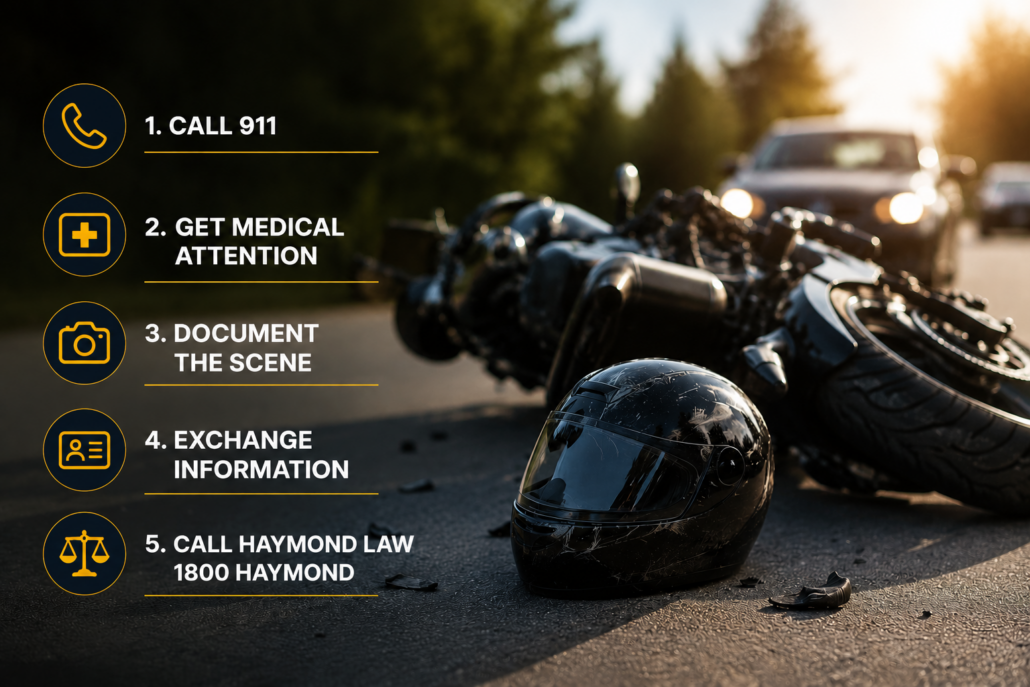

Motorcycle accidents can happen in seconds — but the physical, emotional, and financial effects can last for months or even years. If you’ve experienced a motorcycle accident in Connecticut, you know that unlike passengers in cars, motorcyclists have very little protection during a collision, making serious injuries far more common.
If you were injured in a motorcycle accident in Connecticut, knowing what to do immediately after the crash can protect both your health and your legal rights.
At Haymond Law Firm, we’ve helped injured riders throughout Connecticut, Massachusetts, New York, and Vermont recover compensation after serious motorcycle accidents. This guide explains the most important steps to take after a motorcycle crash and how to avoid mistakes that could hurt your case.
1. Call 911 and Seek Medical Attention Immediately
After a motorcycle accident, adrenaline can hide pain and symptoms. Even if you believe your injuries are minor, it is critical to seek medical attention as soon as possible.
Motorcycle accident injuries commonly include:
- Concussions and traumatic brain injuries
- Neck and back injuries
- Broken bones
- Road rash
- Internal bleeding
- Shoulder and knee injuries
- Spinal cord injuries
Some injuries may not appear until hours or days later.
Calling 911 also creates an official accident report, which can become important evidence for your injury claim.
2. Move to Safety if Possible
If your motorcycle is creating a hazard and you are physically able to move, try to get yourself to a safe location away from traffic.
Do not remove your helmet immediately unless necessary for medical reasons.
If the motorcycle is severely damaged, leaking fluids, or smoking, stay clear of the vehicle until emergency responders arrive.
3. Take Photos and Videos of the Accident Scene
One of the most important things you can do after a motorcycle crash is document the scene.
Try to capture:
- Damage to all vehicles
- Your motorcycle
- Road conditions
- Traffic signs and signals
- Skid marks
- Weather conditions
- Your injuries
- Helmet and riding gear
- The position of the vehicles
Photos can help prove how the accident happened and may prevent insurance companies from disputing your claim later.
4. Get Contact Information From Everyone Involved
Collect information from:
- The other driver
- Witnesses
- Police officers at the scene
Important details include:
- Names
- Phone numbers
- Insurance information
- Driver’s license numbers
- License plate numbers
Witness statements can be especially valuable in motorcycle accident cases because insurance companies often try to unfairly blame riders for crashes.
5. Do NOT Admit Fault
Even saying something simple like “I’m sorry” can later be used against you by insurance companies.
Stick to the facts when speaking with police and other drivers.
Do not speculate about:
- speed
- fault
- visibility
- injuries
The full details of the accident may not be clear until a full investigation is completed.
6. Avoid Speaking to Insurance Adjusters Alone
After a motorcycle accident, insurance companies may contact you quickly and ask for a recorded statement.
Be careful.
Insurance adjusters are trained to minimize payouts and may try to:
- get you to accept blame
- downplay your injuries
- pressure you into a low settlement
- use your statements against you later
Before speaking with an insurance company, it is often best to consult with an experienced motorcycle accident attorney.
7. Follow Your Doctor’s Treatment Plan
Missing medical appointments or stopping treatment early can hurt both your recovery and your injury claim.
Insurance companies often argue that:
- gaps in treatment mean you were not seriously injured
- you recovered quickly
- your injuries were unrelated to the accident
Keep records of:
- medical visits
- prescriptions
- physical therapy
- imaging results
- out-of-pocket expenses
8. Understand Connecticut Motorcycle Accident Laws
Connecticut follows a modified comparative negligence rule.
This means you may still recover compensation if you were partially at fault for the accident — as long as you were not more than 50% responsible.
Insurance companies frequently try to place unfair blame on motorcycle riders. Common arguments include:
- speeding
- lane positioning
- visibility issues
- aggressive riding
An experienced motorcycle accident lawyer can help fight back against these tactics.
9. Common Causes of Motorcycle Accidents in Connecticut
Many motorcycle crashes happen because drivers fail to see motorcyclists.
Common causes include:
- Distracted driving
- Unsafe lane changes
- Left-turn accidents
- Speeding
- Drunk driving
- Following too closely
- Failure to yield
- Poor road conditions
Motorcycle riders are often some of the safest and most aware drivers on the road — yet they are still placed at risk by careless drivers.
10. What Compensation Can You Recover After a Motorcycle Accident?
Depending on the circumstances of your case, you may be entitled to compensation for:
- Medical bills
- Future medical treatment
- Lost wages
- Loss of earning capacity
- Pain and suffering
- Emotional distress
- Motorcycle damage
- Permanent disability
- Scarring and disfigurement
Every motorcycle accident case is different, which is why it is important to have your case reviewed by a qualified attorney.
Why Motorcycle Accident Cases Are Different
Motorcycle accident claims are often more complex than regular car accident cases because injuries are typically more severe and insurance companies frequently stereotype riders unfairly.
At Haymond Law Firm, we understand the unique challenges injured motorcyclists face.
Our team fights to protect riders and help them pursue the compensation they deserve after serious accidents.
Frequently Asked Questions About Motorcycle Accidents
How long do I have to file a motorcycle accident claim in Connecticut?
Connecticut generally has a statute of limitations for personal injury claims. However, deadlines can vary depending on the circumstances of the case, so it is important to speak with an attorney as soon as possible.
Should I hire a lawyer after a motorcycle accident?
If you suffered injuries, missed work, or are dealing with insurance companies, speaking with a motorcycle accident lawyer can help protect your rights and maximize your compensation.
What if the other driver says the accident was my fault?
Insurance companies often try to blame motorcyclists unfairly. Evidence such as witness statements, crash reports, photos, and surveillance footage may help prove what actually happened.
Can I still recover compensation if I was not wearing a helmet?
Possibly. Connecticut motorcycle accident laws can be complicated, and not wearing a helmet does not automatically prevent you from pursuing compensation.
Contact Haymond Law Firm After a Motorcycle Accident
If you or a loved one were injured in a motorcycle accident in Connecticut, Massachusetts, New York, or Vermont, the team at Haymond Law Firm is here to help.
Our attorneys understand the serious impact motorcycle accidents can have on riders and their families, and we fight aggressively to help injured clients pursue the compensation they deserve.
📞 Call 1-800-HAYMOND today for a free consultation.
Related Searches
- Connecticut motorcycle accident lawyer
- Hartford motorcycle accident attorney
- motorcycle injury lawyer near me
- motorcycle crash attorney Connecticut
- what to do after a motorcycle accident
- motorcycle accident settlement Connecticut
- injured motorcycle rider lawyer
- Connecticut motorcycle injury claim