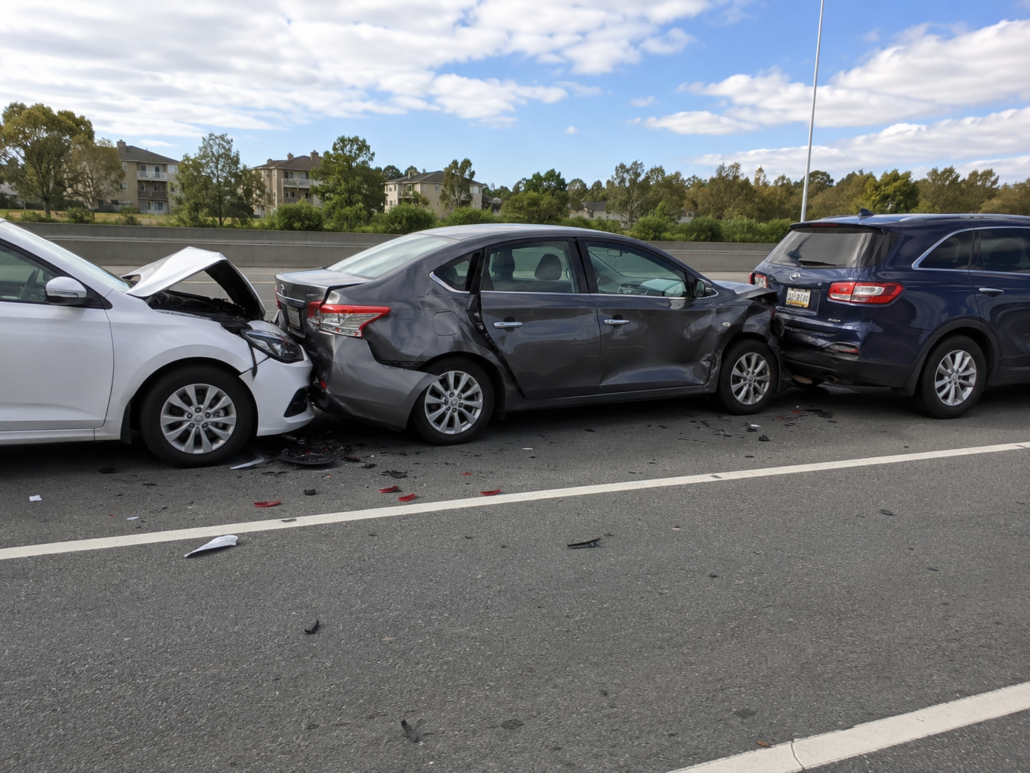

The driver who starts a chain-reaction collision may be primarily responsible for a three-car pileup, but fault is not automatically assigned based only on where each vehicle was positioned. Investigators must determine the order of impact, the actions of every driver, and whether more than one person contributed to the crash.
Three-car accidents can be significantly more complicated than collisions involving only two vehicles. Each driver may provide a different version of what happened, multiple insurance companies may become involved, and one vehicle may sustain damage to both the front and rear.
A driver who was pushed into another vehicle should not automatically be treated as though they caused the second impact. At the same time, the driver at the back of the pileup is not necessarily responsible for every part of the accident.
If you were injured in a multi-vehicle collision, the experienced Connecticut car accident attorneys at Haymond Law Firm can review the evidence, explain your legal options, and help determine which parties may be responsible.
What Is a Three-Car Pileup?
A three-car pileup is a collision involving three vehicles, usually occurring within a short period of time and in the same immediate area.
Many three-car crashes are chain-reaction rear-end accidents. One vehicle strikes another from behind, pushing it into the vehicle ahead. However, three-car accidents can also involve:
- Unsafe lane changes
- Intersection collisions
- Vehicles merging into one lane
- A driver crossing the center line
- A vehicle spinning after an initial impact
- A disabled vehicle stopped in traffic
- Commercial trucks or delivery vehicles
- More than one separate impact
Determining responsibility requires more than simply identifying the vehicle with front-end or rear-end damage. Investigators must establish how the collision began and what happened during each impact.
Who Is Usually at Fault in a Three-Car Rear-End Accident?
In many three-car rear-end collisions, the driver who caused the first impact may be held primarily responsible.
Connecticut law requires drivers to maintain a reasonable and prudent following distance based on traffic, speed, road conditions, and weather. A driver who follows too closely and cannot stop in time may be found negligent.
However, every three-car accident is different. Liability may depend on whether the middle vehicle had already struck the first vehicle before being hit from behind.
Scenario One: The Third Car Pushes the Middle Car Forward
Consider three vehicles stopped in traffic:
- Vehicle One is stopped at the front.
- Vehicle Two is properly stopped behind Vehicle One.
- Vehicle Three fails to stop and rear-ends Vehicle Two.
- The force pushes Vehicle Two into Vehicle One.
In this situation, the driver of Vehicle Three may be responsible for both impacts because Vehicle Two would not have struck Vehicle One without first being hit from behind.
Evidence that may support this version of events includes statements from the drivers, photographs of the damage, witness accounts, dash-camera footage, and the occupants of the middle vehicle reporting that they felt only one impact.
Scenario Two: The Middle Car Hits the First Car Before Being Rear-Ended
Responsibility may be divided differently if Vehicle Two first rear-ends Vehicle One and Vehicle Three then crashes into Vehicle Two.
In that situation, two drivers may have independently failed to stop:
- The driver of Vehicle Two may be responsible for the initial collision.
- The driver of Vehicle Three may be responsible for the second collision.
- Either driver’s conduct may have contributed to the injuries and damage suffered by the people in the other vehicles.
This type of accident may involve multiple insurance claims and disagreements about which impact caused a particular injury.
Scenario Three: The Front Driver Contributes to the Collision
The front driver may share responsibility in certain circumstances, such as when that driver:
- Reverses unexpectedly
- Changes lanes without warning
- Stops in an active travel lane without justification
- Operates a vehicle without functioning brake lights
- Makes an unsafe turn
- Enters traffic without yielding
- Drives recklessly before the collision
A sudden stop alone does not necessarily make the front driver responsible. Drivers are generally expected to leave enough space to react to changing traffic conditions. The specific facts must be investigated before fault can be determined.
Is the Last Driver Always Responsible for a Three-Car Pileup?
No. The last driver is not automatically responsible for every three-car accident.
The vehicle at the back is often closely investigated because rear-end crashes frequently involve following too closely, speeding, distraction, or failure to stop. However, its position does not establish liability by itself.
The last driver may have a defense if the evidence shows that:
- Another vehicle suddenly entered the lane
- The middle vehicle made an unsafe lane change
- A vehicle was stopped without lights at night
- A mechanical failure contributed to the crash
- Hazardous road conditions made the collision unavoidable
- A different driver had already caused the initial accident
- Multiple drivers acted negligently
Insurance companies may attempt to make an early fault determination before all available evidence has been collected. That is why drivers should preserve photographs, videos, witness information, police documents, and damaged vehicles whenever possible.
Can the Middle Driver Be Held Responsible?
Yes. A middle driver can be held responsible if their own actions contributed to the accident.
For example, the middle driver may share fault if they:
- Rear-ended the front vehicle before being struck
- Followed the front vehicle too closely
- Made an unsafe lane change
- Was distracted
- Was speeding
- Failed to maintain working brake lights
- Stopped abruptly for an improper reason
However, a middle driver who was safely stopped and pushed forward by another vehicle may not be responsible for the resulting impact.
This distinction is important because the middle vehicle commonly has damage to both its front and rear. The existence of front-end damage does not prove that its driver caused the collision.
Can More Than One Driver Be at Fault in Connecticut?
Yes. Connecticut follows a modified comparative negligence system.
Under Connecticut law, an injured person may generally recover damages when their negligence is not greater than the combined negligence of the parties from whom compensation is sought. Any recovery may be reduced according to the injured person’s percentage of responsibility.
For example, imagine that an injured driver has $100,000 in recoverable damages but is found 20% responsible for the collision. The driver’s recovery could be reduced by 20% to reflect that share of fault.
Comparative negligence is especially important in three-car accidents because the insurance companies may each attempt to shift responsibility onto another driver.
What Evidence Helps Determine Who Caused a Three-Car Accident?
A successful investigation should focus on the complete sequence of events rather than only the final positions of the vehicles.
Police Reports
A police report may contain:
- Statements from the drivers
- Witness information
- A diagram of the accident
- Road and weather conditions
- Observed vehicle damage
- Citations issued at the scene
- The responding officer’s observations
A police report can be important evidence, but it may not contain every fact needed to determine civil liability.
Photographs and Videos
Photographs should show:
- All sides of every vehicle
- The position of the vehicles
- Skid marks
- Debris
- Traffic lights and signs
- Lane markings
- Road conditions
- Nearby businesses or homes with cameras
Dash-camera, traffic-camera, and surveillance footage may help establish the timing and order of the impacts.
Vehicle Damage
The location and severity of vehicle damage may help an investigator understand how the collision occurred.
For example, damage to the rear of the middle vehicle and the front of the last vehicle may support a rear-end impact. Damage to both ends of the middle vehicle may indicate that it was compressed between two vehicles, but additional evidence is usually needed to determine whether the middle vehicle was pushed forward.
Haymond Law Firm’s car accident legal team has experience evaluating complicated crashes. The firm also has the ability to create accident-reconstruction videos and has a property-damage specialist on staff to assist with vehicle-related issues.
Witness Statements
Independent witnesses can be particularly valuable when the drivers disagree.
A witness may have seen:
- Which collision happened first
- Whether traffic was stopped
- Whether a driver was speeding
- Whether someone changed lanes
- Whether brake lights were working
- Whether a driver was using a phone
Witness contact information should be collected as soon as possible because it may become more difficult to locate witnesses later.
Event Data and Electronic Records
Certain vehicles contain event data recorders that may preserve information about speed, braking, acceleration, and seatbelt use immediately before a collision.
Depending on the circumstances, cellphone records, commercial vehicle records, GPS information, and rideshare or delivery-app data may also become relevant.
What Should You Do After a Three-Car Pileup?
The moments after a crash can be confusing, but the steps you take may affect your health and your ability to document what happened.
Call 911
Report the accident and request emergency medical assistance when anyone may be injured.
Seek Medical Care
Some injuries are not immediately obvious. Adrenaline can temporarily mask pain, and symptoms may develop or worsen later.
Tell medical providers that your symptoms began after the collision and follow their recommendations for additional treatment.
Photograph the Scene
When it is safe to do so, photograph all three vehicles, the roadway, debris, traffic controls, skid marks, and visible injuries.
Do not limit your photographs to your own vehicle. Damage to the other vehicles may be important when determining the order of impact.
Exchange Information
Obtain the following from each driver:
- Name
- Address
- Telephone number
- Driver’s license information
- Vehicle registration
- Insurance company
- Policy information
- License plate number
Identify Witnesses
Ask witnesses for their names, phone numbers, and email addresses. Do not assume that their information will automatically appear in the police report.
Report the Accident to Your Insurance Company
Notify your insurer promptly, but be careful when discussing fault or providing detailed statements before the accident has been fully investigated.
Do Not Rush Into a Settlement
An early settlement may not account for ongoing treatment, lost income, future medical care, or injuries that have not yet been fully diagnosed.
Before signing a release, consider speaking with a lawyer who can review the proposed settlement and explain what rights you may be giving up. Additional answers are available in Haymond Law Firm’s car accident FAQ.
What Compensation May Be Available After a Three-Car Accident?
The compensation available depends on the facts of the accident, the available insurance coverage, the extent of the injuries, and each party’s share of responsibility.
A claim may include compensation for:
- Emergency medical care
- Hospital bills
- Physical therapy
- Diagnostic testing
- Surgery
- Future medical treatment
- Lost wages
- Reduced earning capacity
- Vehicle repairs or replacement
- Rental-car expenses
- Pain and suffering
- Loss of normal activities
When several people are injured, available insurance coverage may become a major issue. Multiple injured parties may be making claims against the same policy limits.
The firm’s published car accident case results demonstrate the wide variety of factual, medical, and insurance issues that can arise after a collision. Every case is different, and past results do not guarantee a similar outcome.
How Long Do You Have to File a Connecticut Car Accident Lawsuit?
Connecticut generally requires negligence actions involving personal injury or property damage to be brought within two years from when the injury was first sustained or discovered, or reasonably should have been discovered. The statute also contains a three-year outside limitation measured from the act or omission at issue. Exceptions may apply, so injured people should not wait until a deadline is approaching to seek legal advice.
Insurance-company deadlines, notice requirements, claims involving government vehicles, and other circumstances may create additional time limits.
How Can Haymond Law Firm Help After a Three-Car Pileup?
Multi-vehicle accident cases may require an investigation involving several drivers, witnesses, insurance carriers, medical providers, and damaged vehicles.
The Haymond Law Firm legal team can review the circumstances of the crash and work to identify all potentially responsible parties and available insurance coverage.
Led by Attorney John Haymond, who has represented seriously injured people for more than 40 years, the firm handles motor vehicle accident claims throughout Connecticut and other areas of the Northeast.
Depending on the case, the investigation may include:
- Obtaining police records
- Interviewing witnesses
- Reviewing photographs and video
- Examining vehicle damage
- Communicating with insurance companies
- Collecting medical records and bills
- Documenting lost income
- Investigating available insurance policies
- Consulting appropriate experts
- Preparing the case for litigation when necessary
Haymond Law Firm has office locations throughout Connecticut, including Hartford, Bridgeport, New Haven, Waterbury, New London, Danbury, Torrington, and Stamford.
Frequently Asked Questions About Three-Car Accidents
Who pays when one vehicle is pushed into another?
The driver who caused the impact that pushed the vehicle forward may be responsible. However, the order of impact must be established through evidence such as vehicle damage, witness statements, photographs, and video.
Does front-end damage mean the middle driver was at fault?
No. A middle vehicle may have front-end damage because it was pushed into the vehicle ahead. Front-end damage alone does not establish which impact occurred first.
What happens when all three drivers tell different stories?
The insurance companies and attorneys may compare the drivers’ statements with physical evidence, photographs, videos, witness accounts, police records, and vehicle data.
Can two drivers be responsible for the same accident?
Yes. More than one driver may share responsibility when separate negligent actions contribute to the pileup.
Can a passenger file a claim after a three-car accident?
An injured passenger may be able to pursue compensation from one or more responsible drivers. Because passengers generally did not control any of the vehicles, their claims may involve several insurance policies.
Should I give the other insurance company a recorded statement?
You should understand your rights before providing a recorded statement. An insurance adjuster may ask questions designed to evaluate fault, injuries, and the value of the claim.
What happens if the police report is wrong?
A police report is not always the final determination of civil liability. Other evidence may be used to challenge an inaccurate or incomplete account of the accident.
Do I need an attorney for a three-car pileup?
Not every accident requires legal representation. However, an attorney may be helpful when fault is disputed, several insurance companies are involved, injuries are serious, or the available coverage may be limited.
Speak With a Connecticut Car Accident Attorney
Determining fault after a three-car pileup requires a careful review of how the crash began, the sequence of impacts, and the actions of every driver.
Haymond Law Firm represents injured drivers and passengers throughout Connecticut. Consultations are free, and the firm states that clients are not charged legal fees unless compensation is recovered. The firm is available 24 hours a day at 1-800-HAYMOND.
Contact Haymond Law Firm for a free case evaluation and tell the team what happened.
If you fall down, we’ll pick you up.
This article is provided for general informational purposes only and does not constitute legal advice. Reading this article or contacting Haymond Law Firm does not create an attorney-client relationship. Every case is different, and prior results do not guarantee a similar outcome.